
διάψαλμα
: The Thinnings
διάψαλμα
: The Thinnings
‘I have been studying how I may compare
This prison where I live unto the world:
…
I cannot do it; yet I’ll hammer it out.
My brain I’ll prove the female to my soul;
My soul the father: and these two beget
A generation of still-breeding thoughts.’

[The Tragedy of Richard the Second; v. iv. 1-2, 5-8]
The pursuit of wisdom is the greatest objective that a man can seek. It is the way of life to the high lands where the air is thinner, the view is further, the light is more crystalline, and the sound is more silent. For most - perhaps all - of us there have been and yet may be these moments where we have sat with the ancient Hebrew prophet Eliyahu and listened into the abundance of all-consuming silence. We too may have heard the whisper of a hint of a nigh-silent breath of wind.
The feeling of having exited from the hectic cacophony of normal life and entered into a place of timeless silence. For those of us so given such a rare gift there is a strange feeling of belongingness. And once you have tasted this manna - this what-is-that? - you instantly are enwombed by a feeling of homecoming. For this exalted place outwith everything normal is like a well-fitting gown that appears to have been carefully tailored, waiting on its peg, ready for you to slip into.
And for a brief moment which is outside time and space, you feel that you truly belong. This place is the apartment which the Master promised he would go and prepare for you. One where you fit snugly in.
Well, I wonder, if we have forgotten that this is the place where we itch and need to be scratched. Like everyone else, I wander around in this oh-so-ancient world, passing my impermanent time, day processing into day, and then through these capsules of twenty-four hours linearly towards the next earth-bound season. Winter, in this case; as the temperature drops towards freezing I watch the steam of fellow-citizens walking by, breathing out warm clouds, their proof of life continuing.
Strangely, perhaps, our fellow-walkers do not think about their walking, breathing, arm-swinging, heart-beating, blood-pumping. All the essentials of the living organism, the animalistic zoe life are unconsidered, as our mind is engulfed by the bios life that we must live - the purposeful drive that tells us we must leave the home at 7.15am, and walk to catch the X99 bus, to reach the necessary destination.
And, it is a necessary destination. The journey is important, but only because the destination is the purpose of our travel in time and in space. Unbeknown to us our homely terrestrial ball of rock, air and water speeds on from the big bang to the final crump at an improbable velocity (about 100,000kmph), spinning seasonally around the sun, circled slowly by the ever-grinning grey lunar rock in the sky, which itself spins around us every four weeks.
I’ve said this before, and I am happy to re-commend this to the astral sceptic. If one night you want to see that the moon is at core just a big ball just hanging above the air, then buy a set of binoculars and focus in on the moon (you can’t miss it; its the shiny grey circle in the sky). Once you focus in on it your brain will quickly confirm - yes, your brain will affirm - that this is indeed a big ball of extremely heavy rock just hanging there right above you.
Further, if you want to experience a personal view of the entire universe then find a place away from city lights, on a starry starry night, place a blanket on the ground, lie down face up and just look at the stars. After a short period of time you will see a remarkable transformation which will change your perception of life. For the brain will think that the brighter stars are closer than the duller stars, making the entire sky above you flip - suddenly! - into three dimensions. The effect is quite astonishing. You will then understand that you are standing on a small green-blue ball, in empty space, and the whole visible universe is all around you. Hence the blanket; if you do this standing the tendency is to fall down in vertiginous awe.
Behold. The Man!
There is a necessary requirement to see, understand and apply the wisdom that we are each not the (or, a) universe. There is a power that is encountered in thin places. Events in time that bring each of us out of the ever-present stuff of certainty and beyond the flimsy curtain which separates each of us from eternity. There are beautiful video clips of babies, children and adults experiencing hearing and seeing for the first time. Watch them and weep in their joy. For the ignorant - literally, unknowing - individual when hearing the first word or seeing the first face does not react with absolute bafflement at this entirely novel effect, but with joyful recognition that this is what they already knew existed, but had never before experienced.
Yes, we each eventually fit into the immanent world of ApplePay, coffee machines and supermarkets, yet, albeit never fully at ease. But we each fit smoothly into a natural world of extraordinary experiences that are, despite previously unknown, from the start fully understandable, however early or late in life it takes us each to encounter them. Does it not seem most odd that when the home Internet goes down, or when we start a new job, there is a period of tense confusion until normality resets and resumes; yet (for those who do this) a prayer invoking the eternal I AM is found instantly and perfectly to be working, even if we have never done this before.
There is an ancient truth that we have, by default, blocked auricles and opticals.
I am an old fuddy-duddy in so many ways. I love physical books, their heft, texture and smell. I also love music, which comes to me via an old hi-fi system. Every time I move house I have to unplug the six seperates, and their sixteen cables, box them up, then with great concentration rewire every connection correctly (there must be over 10,000 wrong ways to do this.) After an hour or two of careful plugging in and out, music will suddenly and faithfully reappear from the mad bundle of boxes and wires. Yet, if I wish to pray, I just say, ‘Dear Father …’ and that is all; Heaven lies open. Indeed, prayer helps immensely when rewiring a hi-fi system.
What then are the thin places (I prefer ‘a thinning’) such as Eliyahu’s cave and Moshe’s thorn bush? Someone once said to me that some of these are places already well used by past people for prayer, saturated by heavy use. Like art galleries of the soul where ancient human-divine magnificence pre-exists our little presence. These are permanent places where the time and space of our rushing, hurtling through the universe is locked out. Places which appear to run at right angles to the winds of time. Crossroads which are neither toing or froing, passing or proceeding. Where the apostle Paul said he felt the depth, breadth, height and length of the timeless permanence and boundless everness of that Anointing.
I first walked into a thinning during a deeply confused time a quarter of a century ago. Until then my life and faith were rational and physical. But Winston Churchill’s black dog - depression - had laid me low. I went for three days and nights to a restored fourteenth century Benedictine abbey where twenty eight men prayed, worshipped, sang and worked in a bond of peace. Time stood still, marked only by the tower’s singular bell, calling the monks and visitors to divine worship or adoration more than six times every day.
By the passing of the days and nights there were three days, but by the much slower inner clock I recall three months. It was as-if I had travelled out to the abbey and then back to my family, but some new Einsteinian law slowed down the outside world allowing our time to pass at one thirtieth of the slow-mo normal rate; yet it seemed that we were in the slow lane. I’m just saying how it was. I returned home saner and wiser.
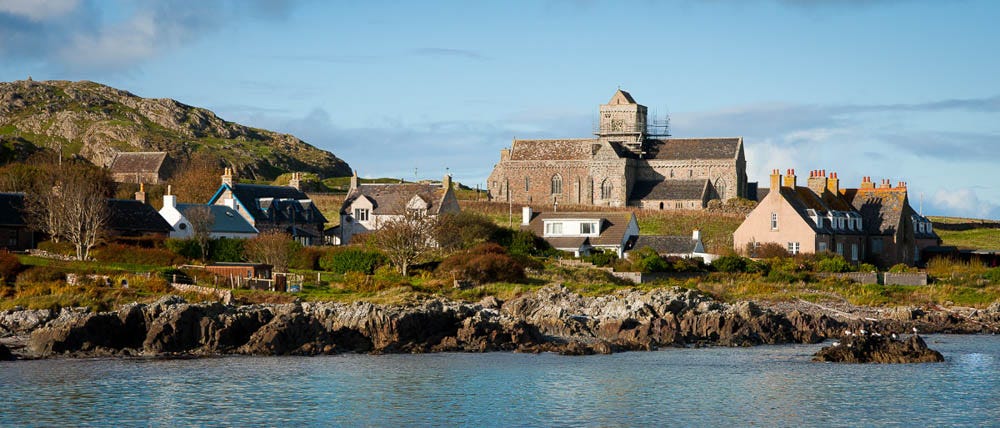
More recently, I was introduced to a thinning on an island about twenty miles away. This was on a very small peninsula on the rugged west coast, with the ruins of a sixth century Brytthonic chapel named after the first evangelist ever to tread these lands. The old stone walls are about one foot high, and when you enter into the chapel a huge calm and peace falls, the wind departs, and you are somewhere far further away from the big city than can be imagined. There are rocks there with crosses naturally in them, clouds above have been seen to form a cross, otters play and laugh in the waters, and three holy wells distill the salty seawater into such freshness that in spring there are tadpoles. Even today some locals swim in this bay and local priests sample the springs for holy water.
I could go on to speak of a house I once lived in which had been deliberately built upon a thousand year old abbey ruin. The nineteenth century religious iconoclasts had done this to destroy the ancient site. They even renamed the land to hide the ancient name. But, the one hundred and fifty year old maps recorded the lost chapel and its saints’ bones, and everyone who visited spoke of the astonishing peace that existed in the house and its gardens.
In these Celtic islands of Scotland, Ireland and beyond there is a most singular feature: many of these ancient Christian sites were deliberately built in pre-existing holy sites. The pagan holy wells were rededicated and retained, the stone circles were re-accommodated with the addition of a chapel (‘kirk’) at centre of the circle (‘circe’) and elaborately carved stone crosses added to the already ancient stones placed there by thinners many centuries and millennia before. In the ancient Pictish kingdom of Fife, where a Greek monk had fled across many seas carrying the bones of the Apostle Andrew, on the cliff-edge above where he ran aground in a storm, there was a holy oak grove near a forest of wild boars. There a chapel was built to Our Lady, and later a cathedral to the sacred memory of the Galilean fisherman. A local school has a badge with a cross, a wild boar and an oak tree.
I have often wondered what it was that converted these lands from barbaric paganism. There is ample evidence across western Europe that human sacrifices and related cults once prospered. And, I wonder, in a harsh liminal existence where the gods required priestly sacrifices of your family members in order to calm their unpredictable, violent wrath, did this new-found Christian faith bring hope into the darkness: there is no longer any need for further death, for Christ has died, once and for all time, as was celebrated by unbloodied cup-bearing priests serving at the bread feast of the mass. There was no need to remove all evidence of the past, for even their fathers - who were less ignorant than most are today - had been god-seeking from their time of arrival in these harsh northerly Atlantic shores.
We live today in a newly circumcised era where all old knowledge is to be cut off and thrown away. It is truly an agnostic age: one where there is no knowledge beyond what our short-lived heads and ever-ageing bodies can perceive and accumulate. When we die, all this is lost. Today there is not even a grave to pass something of us on to the next generation of human, animated dust. We are born, live and die. That is all we are now.
So they say. Yet there remain still these thinnings which have survived the tumbleweeds, deluges, and falling rocks of time’s lengthy passage. They are not in your Etsy app promos, or your infinite social media posts, or in any of the ads that annoyingly chop up your hours of binge watching. They are not in your electronic gadgetery, nor in an Ikea furniture maze, nor in the shopping porn that is Christmas. If you can be bothered to make your way in search of them, there is a strange effect: it seems that they will come to you, like the far travelling magi and meet you on your pilgrimage.
May I suggest: put that dull device down, get out to where reality waits to be encountered, and experience everything at your own first hand. While you still can. If you must, then blog about it with your own photos and in your own words.
“May the road rise up to meet you. May the wind be ever at your back. May the sun shine warm upon your face, and rains fall soft on your fields. And until we meet again, May God hold you in the palm of His hand.”