
Genesis 2
Men& Women, Good and Evil, and Shabbat
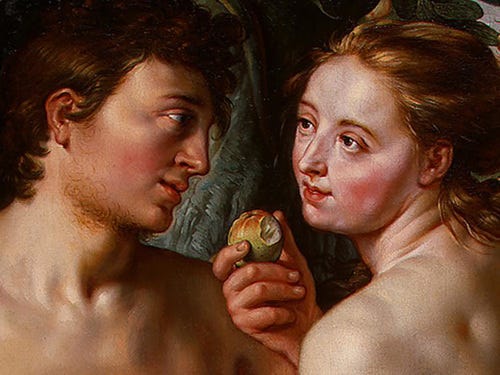
The second chapter of Genesis drops us straight into two areas of disagreement which have been major issues in Christianity almost since Jesus began preaching and teaching in Galilee, Judea and Samaria: the Shabbat as a day of rest (vv1-4), and the relative value and status of men and women (vv5-24). Each of these topics remain a matter of ongoing debate, discussion - and sometimes deep disagreement. But, I want to speak more particularly.
I’m going to open first on the feature that everyone in mankind is either male or female. Let us put to one side the current violent power-grab taking place over whether this is a scale of gendering, with a personal control over one’s location, or not. The Genesis passage here knows nothing of this debate. Doubtless there have ever been a wide range of sexual tendencies in the human race; without this strong urge to have sex, as one person said, the human race would have died out long ago. Why?, because humanity can do so much already with creative thought, words and actions, that sex would be, for all but a small minority, merely a distracting nuisance.
If you want a realisation of this, the 60’s sci-fi movie, Barbarella, captures and mocks attempts to place sex on a par with other forms of human creativity. Indeed, we read in Genesis 2.15-20. Adam is given the task of organising and understanding his own virgin piece of land - the garden in Eden - classifying and naming every living thing. Who knows, but if it weren’t for the annoying (to Adam) where is she itch that there was something missing in his life, perhaps he would have gone on to dabble creatively in fundamental Mathematics, Astronomy and Geology.
There are a couple of give-away words in this chapter which hint that, even in the earliest chapters of the Bible, all is not well, even if everything is ‘very good’ (1.31). First we read of a tree which provides knowledge of the good that God has made, from the appearance of the first light to the first green plants. But, somehow this couples with evil (2.17); yes, the knowledge is of the yin-yang of good-evil. This too will run through the rest of scripture, so any attempt to go beyond a nodding assent to the reality of this troublesome dichotomy is a long-term project that will take mankind, frankly, forever.
The second is that the singularity of Adam is ‘not good’ (2.18). How so? Just a few verses earlier we are told that ‘God saw everything that he had made, and indeed, it was very good’ (1.31). I can only offer the truism we experience when we are in a place of deep peace and harmony - a very good place - but it cannot be perfectly good, for there will be troubling things we are being unaware of, and the ‘very good’ place is one we must inevitably part from. For example, I love hillwalking. The path may be broken, troublingly steep, over soggy ground, plagued by midges (mosquitos) and clegs (horse flies), but when the top is reached there may be a soul-silencing view to enjoy that is only available to the perigrinator, but this moment must pass and we each must descend and return to a duller normality.
We each have a folk memory of a heavenly or earthly garden where all uphill slogs and downhill stumbles are forever over, and existence is only at the mountain top, or wherever your desired paradise may be. One of the sad memories of my youthful atheism is the huge effort I had to put in to deny the existence of this model which was just there in my soul ab initio, ready prepared in my head. Even today a piece of music or line in a book can set off this desire for repossession of the perfect goodness of creation.
And so, we read of the unique problem of humanity, how it was ‘not good’, and how God set about fixing this problem. The story we read (2.18-25) is, like everything we have read so far, a long-established tale, told by fathers and mothers to children and neighbours, from a time way back before Moses and Ezra put this down in letters on parchment. As I hinted before, a tale which outlasts the lifetimes of the speaker and listener is one which retells truths already known. Indeed, these tales were told and retold often over the years until they became a magic spell, gripping the audience. If a word was mis-spoken the audience would shout out the correct word, not as a rebuke, but as a communal reliving and relearning process.
We must approach these early pre-historic Genesis stories as what they are: ancient truths remembered for thousands of years and hundreds of generations. The tale we now have of the creation of a woman to suit the man is necessarily a-sexual. But it is solidly physical, including loneliness, sleep, cutting and healing of flesh, and metamorphosis of cells and form to produce another human: mark 2.
I must return to the great mystery (to an English speaker) that is biblical Hebrew. We can have no doubt that this tale is a Semitic one, for it is filled with all sorts of eastern Mediterranean wordcraft. If we miss this Jewish love of word play then we are in danger of misinterpreting what has been written. I apologise for this short diversion into Hebrew once more (actually, I admit to enjoying this!). Games are being played with the names of the Man and the Woman.
The man is called אָדָם (read from right to left, literally alef-dalet-mem) pronounced as ‘adam’. We are told that ‘adam’ has been come from the earth: אֲדָמָה (alef-dalet-mem-he, pronounced as ‘adamah’). So ‘adam’ is quite literally an earth-man! Is this his name? We are not explicitly told this, but it does no harm to stick to tradition and call him Adam. Speaking personally, my middle name is ‘Norman’, as I am indeed a man from the north of Viking descent. It is good that our names can mean something substantial.
The word play continues with the statement that the newly created woman is said to be a woman because she is drawn from a man. As in English, where ‘man’ is the word root for ‘woman’, so in Hebrew a ‘man’ is אִישׁ (eesh) and a woman is אִשָּׁה (eeshah). Finally, there is a more complex word play on her given name חַיָּה (hawwah) that becomes Zōё (‘life’) in the Greek LXX Bible of the third century BC, and later ‘Eve’ in English. In Hebrew this is a declension of the noun חַי (‘hai’; life) which means ‘living’.
We have two people now, the first is male and the second is female. The man is called ‘earthman’ and is formed out of the earth. The woman is called ‘living one’ who is formed from the man. And they are each made to image God. We can meditate upon these statements. The man is made dependent upon the earth; the woman is dependent upon the man. The woman has a unique role as the guarantor of the continuance of the human race, for they are all dependent upon her, the source of all the living. We are all born of the flesh of Eve, by the seed of Adam.
There is a simplicité in them: they are naked but not embarrassed. We cannot imagine such a state of being, perhaps particularly in our hyper-sexualised society where crass nudity and sexuality is apparently everywhere. But, there is a strong hint of this mystery in the naivety of children, who run around unabashed in private and in public undraped. We can perceive a hint of godlikeness in this, as He is pure, sinless and perfect. Didn’t Jesus say that if we are to become citizens of the paradise which awaits we must become in some ways as innocent as doves and little children?
So, what now of the mystery of the Sabbath (‘seventh’ or ‘rest’ in Hebrew)? First, it is notable that we Christians do not keep the seventh day as Jews do. To Jews the Sabbath rest is from 6pm on Friday until 6pm on Saturday; for we read in Genesis 1 that a day is from evening through to day then up to the next evening. Christians from earliest times - indeed, the first Easter Sunday - kept the day of the Resurrection of Christ as their commemoration day, Sunday. This is both the first day of the week and the eighth day (first day of the new week).
We have also lost the Hebrew 6pm-6pm day for a day that starts at 6am (‘the first hour’) through 9am (third hour), 12noon (sixth hour), 3pm (ninth hour), and night watches of 6-9pm (first watch), 9-12pm (second watch), 12pm-3am (third watch) and 3am-6am (fourth watch). And so our day of rest runs during daylight on a Sunday. There are places in the New Testament where the Hebrew hours are used, particularly during the final week of Christ’s life on earth. But, later, in such as the Book of Acts we see a slip sideways to the norm across the Roman Empire of the 12-hour day and 12-hour night.
Christians keep the Sunday weekly festival as a perpetual celebration of the risen Jesus. However, it has historically held the extra meaning of ‘rest’ for most Christians, at all times, and in all places. There will be much more to read and think on regarding the weekly Shabbat in the lives of Hebrews in the Holy Land, at war with their enemies, and in the wide Diaspora of scattered Jewry after the destructions of Jerusalem, Israel and Judea.
Further, no-one can read the Gospels and remain unaware of the regular conflicts which arose on the issue of Shabbat between the serious Torah scholars and Jesus. These set the field in place for the disagreements which came about with the conversion of the pagan Greeks, particularly at Ephesos in Anatolia and later beyond there into Makedonia, Achaia and Italy. But, these are issues we can tackle in detail when we read them, much later.
   "... for nothing lovelier can be found
    In woman, than to study houshold good,
    And good works in her husband to promote."

            Paradise Lost, John Milton