
Genesis 8
the end of the beginning of creation
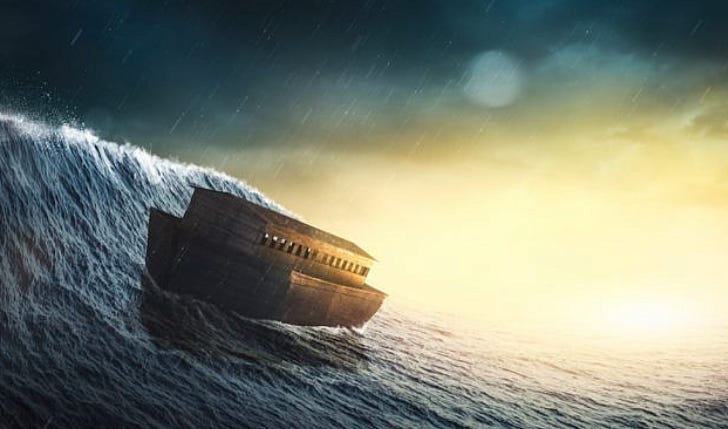
There are two issues related to the story of the Flood which I’d like to tackle in this post. First, the actual reasonableness of the apparently unreasonable numbers we see in the times of the early men from Adam to Noah. Second, the deeper spiritual meanings to be found in this simple tale of one man, his wife, three sons and their wives in a boat.
Numbers
Although the tales we read in the first eleven chapters of Genesis are not of the same character or even of the same eras of mankind, they do illustrate significant points in the Hebraic story of Creation. We can approximately understand the chronological setting of these passages as,
chapter 1 - the creation of everything good, heavenly and terrestrial [pre 4000BC]
chapter 2 - the establishment of mankind, perfect and pure [4000BC]
chapter 3 - mankind’s first disobedience in Eden
chapter 4 - the disintegration of the first human family
chapter 5 - the first establishment of a new line for the restoration of mankind
chapter 6.1-8 - the closing of the free to-and-fro flow between heaven and earth
chapter 6:9-22 - God plans to restart creation [3000BC]
These millenia of time are not as difficult to grasp as they at first may appear to the our modern human mind. Allow me to illustrate: one of my occasional pastimes is to wander around ancient graveyards as they provide a tangible contact between the apparently long past and today. Just six feet of dirt can separate the lively wanderer from the resting saint.
Here lies
Thomas Allerton
Baker
Born 1785
Died 1892
and,
Here lies
Marjorie Smyth
Spinster
Born 1899
Died 2004.
As I stand and read, I’m sure that someone alive today probably knew Marjorie, and perhaps she, in her early years, knew old Thomas the baker. These two individuals cover almost 250 years. Nearby stands a simple stone,
A.B.
AD1654
This person - perhaps Andrew or Anne Black? - whose bones lie just two yards from my feet might have been alive in the 16th century, long before the creation of the United Kingdom. Almost 400 years ago they were walking, talking and worshipping in a church located by the graveyard. That is just 20% of the time between Christ walking in Galilee, and me in lowland Scotland; 10% of the time back to the Exodus; 5% of the time when Abraham left Ur of the Chaldees.
This is not a parlour game or a Maths puzzle. It is simply that we are by nature so unaware of the shortness of civilised mankind’s short spell - possibly just 5000 years - on this little ball of rock and water. What may appear to be large numbers are simply not that big in reality.
This realisation can help us see how the 930 years of Adam’s life cover the first millennium of mankind, perhaps as homo civilis (communitarian, or civilised man), to a close. Now, we begin to read the life of Noah in chapter eight around half-way through the his long life [2500BC]. We should note that Noah in the text occupies the second human millenium, living out his 950 years, dying around 2100BC. This will lead us eventually to the next great figure, the principal actor in the third human millennium, the great patriarch Abraham [2000BC].
Moses will appear around 1500BC, and David five hundred years later [1000BC]. And the final great actor on the stage of mankind’s lively play is of course the Lord Jesus Christ whose birth marks our calendar at the end of the era Before Christ (BC) and onwards into the new era Anno Domini (AD).
A staffer at Glasgow’s excellent Kelvingrove Museum once said to me proudly, “we are erasing the terms AD and BC as they are not inclusive, so now we are using BCE and CE”. I smiled, but decided not to annoy her by pointing out that BCE originally stood for ‘before the Christian era’ and CE ‘in the Christian era.’
So we begin to read Genesis 8, counting forward to sometime around 1500AM (anno mundi) or backwards to 2500BC. It is, as I have shown, a very short period of time, really; Adam has finally died and the focus is now on his righteous descendant Noah, via Seth. Noah is in his sixth century of life when the LORD speaks to him, telling him to build a huge, three-decked ship. The tale lacks important (to us modernists) detail, such as where this took place and what else Noah did during his long apprenticeship as a shipwright (but reading on, Gen9.20 does tell us that he, like Cain, was an agrarian farmer, a “worker of the soil”.)
I have opted to work with the artificial chapter divisions, although 6.9 - 9.19 are artificially parts of the one tale of Noah and his ark. But, it helps to read this detailed tale in smaller chunks. Much is not told: where this takes place, or, most critically, who the story was originally written for. But we can be sure that although Moses authored the Genesis account, the material in these early chapters are not necessarily nor are they likely to have been created entirely by him.
We can read - often gruesome - creation myths in many cultures, usually intended to big up their race memories. Moses is writing to people about God, the only God of his people. The Genesis creation myth is different, it goes out of its way to show God - ‘El’, or ‘Yhwh’ - is not just another God. The sun and moon are called ‘lamps’ as their names were the names of gods. The story is about God, what he has done, and what human beings do.
The text is beautifully crafted and presented, both for what it says of the spiritual heavenly creation, inanimate creation and biological creation. The myth that Western Christians call ‘The Fall’ is again rich in meaning and purport. But, what does the myth of Noah and the Ark possibly mean - why has it persisted down the long millennia of humanity’s struggles with itself? We need to find an answer.
There are two major solutions to understanding the why of this tale: (i) the Jewish understanding, and (ii) the Eastern Orthodox and Western Catholic. To the Hebrew scholars the key is in the first verse of this chapter,
“... and God remembered Noah …”.
It is this profound insight into the heart and soul of Almighty God which goes on to form much of what happens in the Hebrew scriptures,
“... and God was mindful of Abraham …” Gen 19.29
“... and now God remembered Rachel …” Gen 30.22
“... and God remembered his covenant with Abraham and Isaac …” Ex 2.24
To the Jewish reader the unique and extraordinary relationship between the patriarchs, the matriarchs, the people of Israel, and with their God, is one of absent-minded forgetting and of deliberate remembering. A bond which is strained, even to breaking point, yet it is ever renewed by God, the God who is able to do what we cannot do, and his people is an act of solemn repentance and renewal of a covenant of promise.
As Christians we can understand this too, for the Apostle Paul wrote these words of Jesus Christ to his new covenant people, saying, that we should keep the eucharistic feast, and,
“... do this in remembrance of me …”
This act of remembrance in bread and wine is also a reflection, a repentance, a forgiveness given and received, and a renewal of the covenant vows of both parties. We should not allow our dull minds to become blase, for no-one else has such a personal emotionally close God as the God revealed by Moses in his writings.
However, the principal understanding of the ancient Church Fathers, common to the Catholic and Orthodox communities, is one of a huge mystical parable of the entirety of human existence that was enacted by Noah, his saved family, creation groaning, and even the damned who are hell set on not entering the ark. For the ark of Noah is nothing less than The Church. We too must choose to enter. God seals us within it for safety as the Church is buffeted by the powers and storms of hellish chaos; but we and redeemed creation are safely kept inside.
Further, the ark saves us, but we must at some point leave and re-enter the world, to renew the face of the earth and restore the perfection of creation. We must go into the world and make disciples so that more than just a few may be saved. There are further images in the tale. The raven symbolises the forces of darkness which can exist and even thrive in the chaos of the flood’s destruction. The ark floats over the water as the dove does also, like the Holy Spirit did above the first creation’s tohu-va-bohu, and the dove is ever able to return to the ark and the extended hand of its Captain, Noah (who is a type of Christ.) Indeed, Christ can be seen as the ark that saves us, for we are ‘in Christ’, and the dove as the hovering Holy Spirit landing on Noah as was reenacted at the baptism by John.
Also, the dove brings back to Noah, his ship, and the passengers, a severed olive branch. The olive tree signifies the anointing (chrism) of the Holy Spirit returning to the Church. And, further, the ark or the olive branch can be seen as the wood of the Cross where Jesus achieved our salvation. This can also be seen as the branch of David which was promised by Jeremiah,
“Behold, the days are coming, declares the Lord, when I will raise up for David a righteous Branch, and He will reign wisely as King and will administer justice and righteousness in the land.” Jer 23.5
If you step into a traditional church building or medieval cathedral, look up and you will see the main roof above the people is shaped like an upside-down ship. This is called the nave, meaning the ship. We are at sea in an upside-world which is the Church of God, but the last laugh is ours, for we are the people who are setting the world aright. It is not we who are upside down and tapsil tearie, it is the external world. This is a wonderful word to focus on,
“Tapsal-teerie is a vibrant Scots word that means topsy-turvy, upside down, or in utter confusion. It can function as an adverb, adjective, or noun to describe anything from a messy room to a chaotic situation.”
One Ark
We are living in a chaotic world. The long-held certainties of religious and denominational orthodoxy are falling. At least they are with regard to issues which are not actually central to the Christian faith. It is becoming impossible to hold on to such a certainty as was the lived faith of my Scottish Highland forefathers. They were Presbyterian, Calvinist and deeply conformed to the Westminster Confession. But, by another line my Scottish island ancestors were ancient non-reformed Catholic believers. What happened? A marriage in the late 1800’s of my great-grandparents Thomas and Mary!
Since then the family has experienced Baptist, Episcopalian, Catholic, Reformed as well as atheism and agnosticism. If the Church is a ship upon the sea, being battered by rains and wind, avoiding reefs and simply trusting God - I cannot see how there could be 30,000 different such craft, each denying leg room to others who cannot sign up to ‘conditions of passage’ written down last century or 200, 500, or 1,000 or more years ago. We are all in this together. The ship may be old, but she is still watertight.
This is to me the message of ‘Noah and his ark’ for the Church today. 1,000 years back the Western and Eastern churches fell out over political power and Greek/Latin nouns. 500 years later the newly Reformed churches also rejected the old story of there being one visible ark which held the whole church; they had rejected the validity of the Church which was sadly in difficulties. Yet Christ still builds his Church, and the gates of Hell cannot withstand or sink it.
In our world of greater access to ancient writings and other experiences of Christianity, where the Ethiopian Church fights for the ancient faith, as does the Coptic Church, as did the Russian Orthodox Church during 85 years of appalling murderous communist persecution. If their witness is truly genuine, then so too, we must agree, are the ancient writings of such as Augustine of Hippo, Chrysostom of Constantinople, Polycarp of Smyrna and so many more Church Fathers, all of whom belong to the Universal Church, as we do too.
“Finally, brothers, whatever things are true, whatever things are honest, whatever things are just, whatever things are pure, whatever things are lovely, whatever things are of good report; if there be any virtue, and if there be any praise, think on these things.”
Apostle Paul, Philippians 4:8