
John, the Mystical Apostle
understanding the step-son of Mary
John, The Mystic
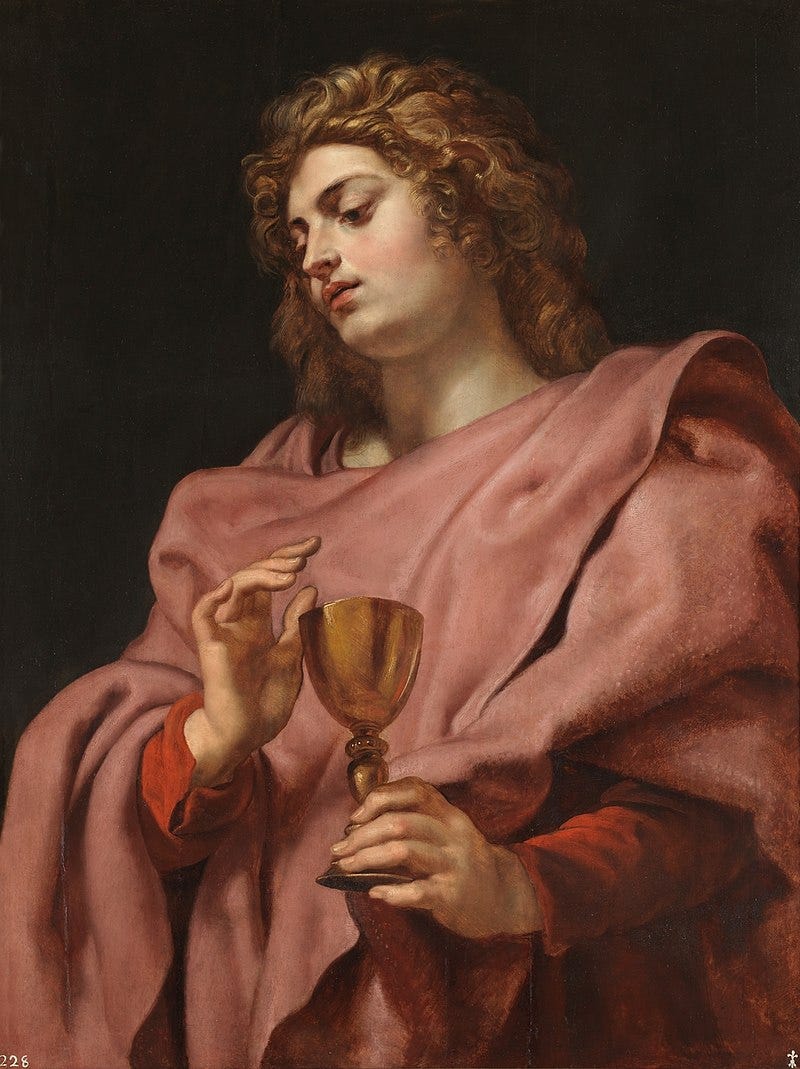
If there is one biblical character above the rest who I feel most attracted and attached to it is the Apostle John. He, almost alone among the male apostles, has a mystical edge to his writings; words which speak beyond cold factuality, inviting the listener to stop, look, and listen. This lectio divina has had its days of apparent absence, and of persecution in Church history, not least John himself with the very early doubts about his astonishing Apocalypse. I give it its original Greek title as it means ‘drawing back the veil’, a veil which, like the curtain in the Jerusalem temple stood between the domain of men holy and ordinary, and the place of Almighty God.
This enveilment was literally present in the absence of any idol or shrine to God in this most holy of holy places. In 63BC the Roman general Pompey ‘the Great’ conquered Jerusalem and entered the temple. He strode right into the Holy of Holies and was astonished to find nothing he had expected: no idol, no shrine, a goat’s head (which he apparently had believed would be there), or anything else. Yet, around a half a century later Zechariah the elderly priest entered the same space and encountered the angel Gabriel and was struck dumb.
In a very real way there is still an oil-and-water mixture in the Christian Church. This in our age is realised by the two wings of rationality and the charismatic. Yet, this is not in any way a novelty; it is a feature which every God-follower has to engage with, if they are to truly follow him. We see this in the life of the Apostle John as he begins to emerge as a person in the gospels. The evidence is scant, but we do see some clear events. He appears firstly as his mother’s son, pushing for one of the top places in the human hierarchy of the Kingdom of God.
Yet as time proceeds we next meet him as an astonished witness at the transfiguration of Christ in his glory on that mountain-top, as Jesus meets and talks with Moses and Elijah. Doubtless John’s brother, James, and his fellow-fisherman, Simon Peter, are equally astonished. We would err if we imagine that there is any one model for the perfect Christian; there are as many as there are people. John has to become the person in Christ that he was meant to be - not another Peter, Matthew or Paul.
The synoptic gospels draw to the end of the tale of Apostle John with his sleepiness on that dread night on the Mount of Olives. He awakes from his dwam only to run away in fear. But, John has more to say in his own gospel; he narrates how he rested his head on the chest of Jesus at the Last Supper, by now recognised by Peter to have a unique bond with the Master. And we also read that he stood with Mother Mary at the foot of the Cross, hearing his final instructions, and watching him as he died.
This John has been radically transformed by his short time, probably around three years, with Jesus, from a pushy rich boy with agendas, to a man of extraordinary character, so trustworthy that the man who knew all about every man, Jesus, would complete his ministry by entrusting his precious and beloved mother into John’s hands. This was a unique privilege and duty, and in no way encroaches upon Peter’s great task, that of building Christ’s Church, for although John was the first man to reach the tomb of Christ, and the first to believe that Jesus had risen, Peter was the one who entered into the dark reality of the empty tomb and was the first man to see clearly that there was no longer a corpse, just the linen bandages that remained.
We then see John with Peter leading the very early Church in Jerusalem in the months which followed. Perhaps we can see here a model of the purposeful realism of Peter, the one who we know had a unique love for Christ, ministering alongside the mystical person of John, who alone amongst the apostles knew that Jesus loved him. Love for and from God, coupled with care and concern for his Mother and the rest of the Church, and working together purposefully to declare the gospel.
John’s final appearance - an aside - in Acts is when King Herod Agrippa I (grandson of Herod the Great) had his brother James killed, then broke up the Peter-John partnership by arresting and imprisoning Peter. At some time during this very early phase of the Church we are told that John took Mary far away to Ephesus, possibly at the great persecution which had been begun in Jerusalem by the Jewish zealot Saul of Tarsus.
The threads are picked up by two major Christian writers, Irenaeus [c130-200] and Clement of Alexandria [c150-215], and are ratified by the historian Eusebius [263-339]. They wrote,
“All the clergy in Asia (Minor) came into contact with John, the Lord’s disciple … testify that John taught the truth to them … he remained with them until the time of (emperor) Trajan [98-117].”
“The church at Ephesus was founded by Paul, and John remained there until Trajan’s time; so she [the church] is a true witness of what the apostles taught.”
“When John moved from the island of Patmos to Ephesus [AD98], he would go when asked to the neighbouring districts of the Gentile peoples, sometimes to appoint bishops, sometimes to organise whole churches, sometimes to ordain one person of those pointed out to him be the Spirit.”
John was clearly a radically active Christian and bishop throughout his life. We can learn this also from his scriptural writings. His unique and mystical grasp on the person of Christ is equalled only by some of Paul’s writings,
“That which was from the beginning, which we have heard, which we have seen with our own eyes, which we have contemplated, which we have handled with our hands, about the Word of God - Life was manifested - for we have seen, and declare to you that everlasting life - with the Father, as manifested to us - what we have seen, and heard, we tell clearly to you … that your joy may be complete.”
“But even if our good news is veiled, it is veiled to those who are perishing, whose minds the god of this age has blinded, who do not believe, should the light of the glorious gospel of Christ, who is the image of God, should shine on them.”
It is perhaps a mistake that Paul is so often handled as an ultra-rationalist, when he was clearly not. John saw Christ transfigured, and by spiritual experience knew that the tomb was empty because Jesus had risen from the dead. Likewise, Paul saw Christ in his risen glory, and instantly knew who he was even before asking,
"δέ τίς εἶ κύριε” - but, who are you Lord?
“ὁ δέ ἐγὼ εἰμι Ἰησοῦς ὃν σὺ διώκεις” - what, I? I am Jesus whom you persecute
Paul would, intellectually, have well understood the implications of calling Jesus ‘Lord’. Yet he knew this within himself. He shows no shock at Jesus’ self-revelation. As John looked in the empty tomb and understood that Jesus was again alive, so Paul looked at the blinding vision and knew he was staring at the living face of God. Personally, I think that Paul would be deeply disappointed to see that so many have sought to reduce his astonishing writings to the status of a Haynes car maintenance manual.
The truths of Christ and his life that John was equipped to teach the Church are not to be learned in a 10am lecture on a Tuesday at a theological seminary. For to know what John knew requires that we go and see what he saw. Then we will understand. The greatest human truths are not held in the mind, but in the heart. That is not to say that the mystical truths of John (and Paul) are in contradiction to the logical truths, more that they are in contradistinction - each contains different truths, and these are compatible.
Our age struggles with these two different kinds of knowing. Radical progressives will propose we create entirely new truths when the old ones are uncomfortable to our lifestyle choices. Radical conservatives propose that if we move back to a re-imagined past we can then capture the glory which has gone. Somehow we must hold the mystical in the left hand and the rational in the right and seek to balance these two truths in our life.
Bernard of Clairvaux (1090-1153) is widely considered to be perhaps the leading exponent of mysticism in Church history. In his meditation upon the Epiphany of Christ (the visit of the Magi) he invites us to ponder,
“What are you doing, Magi? Are you adoring a little baby, in a wretched hovel, wrapped in miserable rags? Can this child really be God? God is in his holy temple; God’s seat is in heaven, so why do you seek him out in a pathetic stable, in the lap of a maiden Mother?
“What are you doing? Are you offering him gold? Is he then a king? If so, where then is his palace? Where is his throne? Where are his royal attendants? Is this stable his palace? This manger his throne? Are Mary and Joseph the entire retinue in his audience-chamber?
“Have you become not wise but fools?, that you are adoring such a small child, who would better be despised for his youth and the poverty of his dwelling? But, yes, these Wise Men have become fools, so that instead they may become wise. The Holy Spirit has breathed upon them as it breathed upon the Apostle, saying, ‘If anyone would become truly wise, let him first become a fool, then he may be wise.’ “
Bernard’s meditation - originally taken from a sermon - invites she who would meditate upon the scene the opportunity to see bright heavenly glory embedded in apparently dark foul dirt. For example, as I read I felt I could smell the odour of animals - sweet breath, sweat and dung - the outdoor night air of such a byre. This is the first step, the next may be to contemplate your own petty foibles which can stop you from seeing God’s glory in, perhaps a tiny noisy child in church, or a beggar in the street outside, or a fully veiled Muslim woman.
For God’s sight is not ours. We must be invited - but never instructed - to turn our eyes elsewhere. Would we have just walked past that stable on that night? Would we have followed the shepherds as they came down off the hills? Would we have knelt before an animal’s feeding trough?
A later mystic, who has been rediscovered only in the past century, was Lady Juliana of Norwich in England (1343-c1416). She has not yet become a great saint, but her meditations and understandings, which she experienced in her monastic cell, offer today’s western Christian, nigh-overwhelmed by life’s modern noise, an escape pod into the presence of God. For she too wrote as she experienced, and came to understand the things of God better than a library of commentaries or endless streaming of YouTube videos.
She wrote,
“The soul which continually seeks God pleases him most fully, for it can do nothing beyond seeking, suffering and trusting. And this happens in the soul by the work of the Holy Spirit. And when we find clarity, this is from the special grace that comes, if he wills it. This seeking in faith, hope and love is what pleases God, and when we find, our soul is filled with joy.
“And what have I learned? That to seek is as good as being answered, for as the soul seeks so it is at work. It is God’s will that we should seek him in order that we may see him. For this is how he shows himself, by his special grace, entirely when it is his will.
“And, when a soul is beholding God, He shall then become its teacher, and that is his honourable will and our great profit, creating an inner strength and quietness, and good virtues, as the Holy Spirit leads by grace. For a soul which has only one attachment, God, and truly trusts him, in his sight and in our beholding, offers to him the greatest honour we can give.”
As I write I received a text from a friend to pray for he is trying to raise money for a business project. Juliana says, we should therefore take this into God’s presence and seek his face. For he can do and give to an infinite degree, but he would rather we learnt first to trust his Fatherly love. Yes, he may give, in his time, but this is not the purpose of our life. He wishes each to know his love, and to know our love in return, way before he wills to give us our so-important yet petty, demands.